Published by: Akash Gupta, Sunshine Cargo Services
Publication Date & Location: 27th March, 2026 ; Kolkata, India
Last Updated: 27th March, 2026

The global shipping industry is currently navigating its most significant disruption in decades. The effective closure of the Strait of Hormuz has sent shockwaves through the maritime world, forcing a massive strategic pivot.

For Indian businesses, the reality is stark: vessels are no longer taking the direct route. Instead, they are rerouting around the Cape of Good Hope, adding thousands of miles and significant delays to every shipment.

This isn’t just a logistics headache; it is a fundamental shift in how we calculate the cost of doing business. If you are importing raw materials or exporting finished goods, the “old” timelines and budgets no longer apply.

๐Ÿ‘‰ Also Read: How India Navigates the West Asia Conflict Impact

What is the Cape of Good Hope Rerouting?

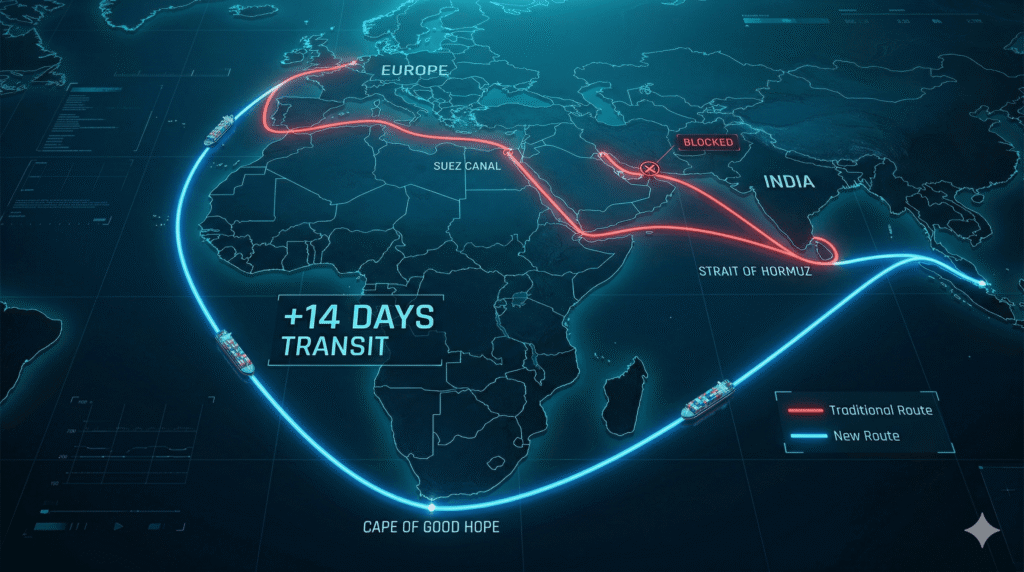
The Cape of Good Hope rerouting is a maritime strategy where vessels avoid the Strait of Hormuz and the Red Sea, choosing instead to sail around the southern tip of Africa.

This detour is essential for vessel safety during periods of high geopolitical conflict. However, it bypasses the primary shortcut between Asia and Europe, fundamentally altering global trade lanes.

By choosing this path, ships must travel an additional 3,500 to 6,000 nautical miles depending on their destination. For an Indian exporter, this adds roughly 10 to 14 days of extra sailing time.

Example: A container traveling from Nhava Sheva to Rotterdam that previously took 24 days may now take upwards of 38 days, delaying inventory turnover and increasing fuel consumption.

Why are Freight Costs Surging by 50%?

Freight costs have skyrocketed because the longer route demands more fuel, more crew hours, and higher insurance premiums.

When ships take the long way around Africa, the global “effective capacity” of the shipping fleet drops. Because each journey takes longer, there are fewer ships available at any given time to pick up new cargo.

This scarcity of space, combined with the massive increase in operational overhead for carriers, has forced base freight rates up by 30% to 50% on key Indian trade routes.

Example: If a standard 40ft container (FEU) previously cost $3,000 to ship to Europe, businesses are now seeing quotes closer to $4,500 before any additional surcharges are applied.

๐Ÿ‘‰ Also Read: India-US Trade Deal 2026 Explained

What are Emergency Conflict Surcharges (ECS)?

Emergency Conflict Surcharges (ECS) are temporary fees levied by shipping lines to cover the extraordinary costs of operating during a geopolitical crisis.

These charges are separate from your base freight and are designed to offset the high cost of War Risk Insurance and the extra fuel burned during the Cape of Good Hope detour.

Currently, these surcharges are ranging between $2,000 and $4,000 per container. For low-margin goods, these surcharges can sometimes exceed the value of the profit margin on the cargo itself.

How is the Hormuz Crisis Impacting Indian Auto Components?

The Indian automotive component sector is one of the hardest-hit industries due to its reliance on “Just-in-Time” delivery schedules.

This sector exports over $21 billion annually. Because many auto parts are heavy and move via sea, the 40% spike in logistics costs is making Indian parts more expensive in global markets.

Beyond the cost, the 14-day delay is disrupting assembly lines in Europe and the US that rely on Indian-made components. This puts Indian suppliers at risk of being replaced by more localized competitors.

Example: A transmission manufacturer in Pune may find their European buyer looking for a Turkish supplier simply because the transit time from India has become too unpredictable.
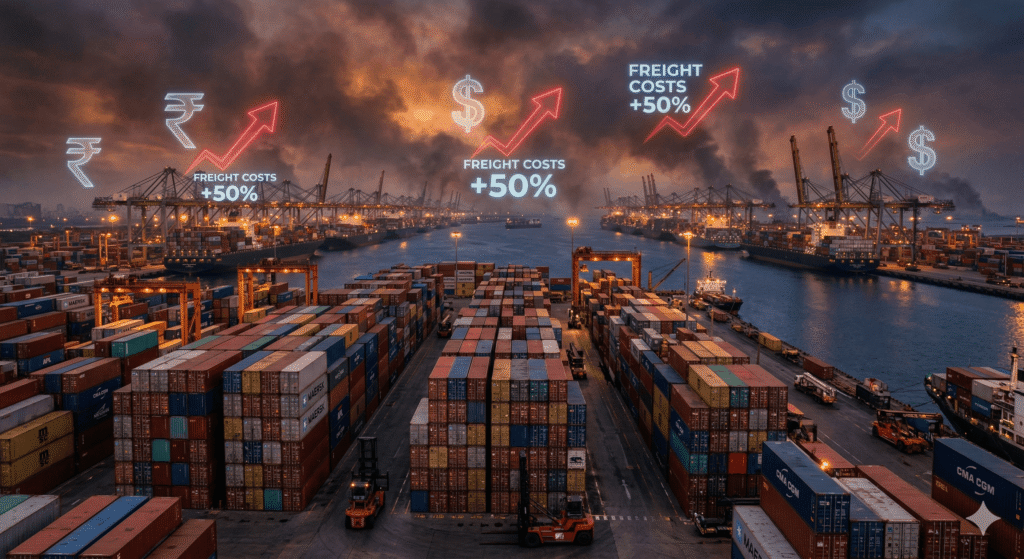
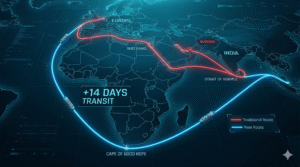
Image showing increased freight charges of shipping containers

Why has Air Freight Increased by 300%?

Air freight has seen a massive price surge because it has become the “emergency escape valve” for desperate shippers.

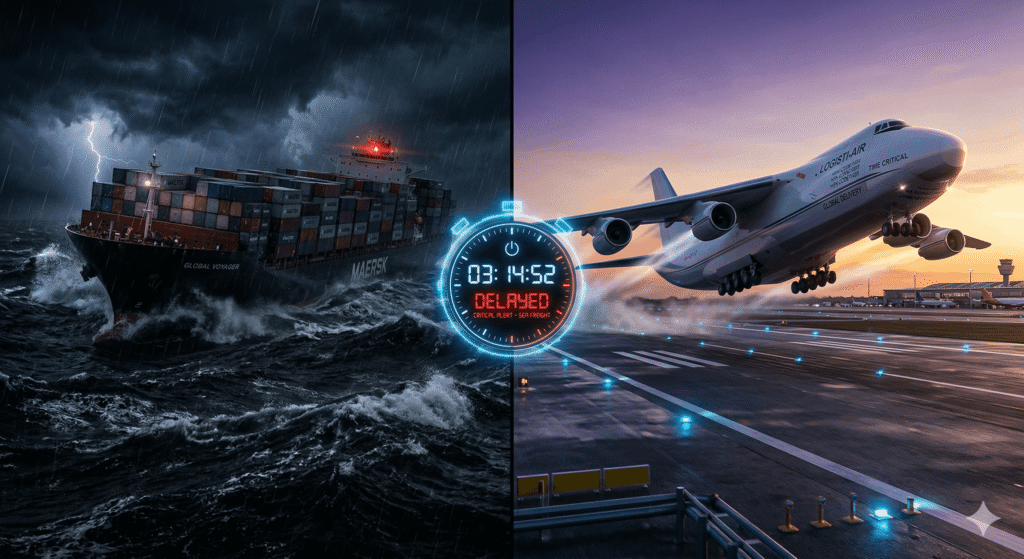
When sea shipments are delayed by two weeks, companies with urgent contracts or perishable goods have no choice but to move their cargo to airplanes. This sudden migration of volume has overwhelmed air capacity.

With limited space on cargo planes flying out of major hubs like Delhi (DEL) and Mumbai (BOM), rates have jumped 250% to 300% as shippers outbid each other for space.

Example: Pharmaceuticals that must stay within a specific temperature range cannot sit on a ship for an extra 14 days. These companies are now paying premium air rates to ensure product integrity.

๐Ÿ‘‰ Also Read: Winners and Losers of the 2026 India-US Trade Deal

What Does the Rupee Depreciation Mean for Importers?

The Indian Rupee has recently slid to approximately 92.33 against the US Dollar, largely driven by the rising cost of energy imports and the trade deficit.

For an Indian importer, this is a double blow. Not only is the freight more expensive in dollar terms, but each dollar now costs more rupees to purchase.

This “currency hit” increases the landing cost of every imported raw material, which eventually leads to higher prices for Indian consumers (imported inflation).

Example: If you are importing specialized chemicals for manufacturing, you are now paying more for the product, more for the shipping, and more for the currency conversion than you were six months ago.

๐Ÿ‘‰ Also Read: Union Budget 2026: Customs Duty Changes & Reforms

How to Navigate Customs and Logistics in this Crisis?

In a volatile market, the role of a customs clearing agent becomes a strategic partnership rather than just a clerical service.

  1. Advance Documentation โ€” With schedules shifting constantly, having your paperwork ready 48 hours early is no longer optional; itโ€™s a requirement to catch tightening vessel windows.

  2. Buffer Stock Management โ€” Importers should consider increasing their “safety stock” to account for the 14-day delay in the African rerouting.

  3. Accurate HSN Coding โ€” With costs rising, avoiding penalties or delays at customs is critical. Ensure every item is classified correctly to prevent “held” shipments.

๐Ÿ‘‰ Learn more: How to Check Bill of Entry Status on ICEGATE (2025 Update)

Frequently Asked Questions (FAQs)

1. Why is the Strait of Hormuz so important for India?

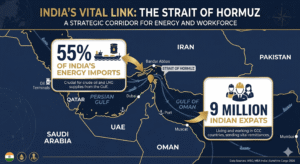
It is the world’s most important oil transit chokepoint. For India, it is the primary gateway for energy imports and a vital link for trade with the Middle East and Europe.

2. How much extra time does the Cape of Good Hope route take?

Generally, it adds between 10 to 14 days to the journey. This depends on the speed of the vessel and the specific port of origin in India.

3. Are all shipping lines charging the Emergency Conflict Surcharge (ECS)?

Most major carriers like Maersk, MSC, and CMA CGM have implemented various forms of surcharges to cover increased operational risks and fuel costs.

4. Will these freight rates come down soon?

Unlikely in the short term. Rates typically remain elevated until the geopolitical situation stabilizes and vessels can safely return to the shorter Suez Canal/Hormuz routes.

5. How does this affect small-scale Indian exporters (MSMEs)?

MSMEs are the most vulnerable as they often lack the capital to absorb a 50% increase in shipping costs or the leverage to negotiate better rates with carriers.

6. Is air freight a viable long-term alternative to sea freight?

No. Air freight is significantly more expensive (often 5-10x the cost of sea). It is only a temporary solution for high-value or time-sensitive goods.

7. Does the rerouting affect insurance premiums?

Yes. Marine insurance providers have increased “War Risk” premiums for any cargo originating from or passing near conflict zones, adding to the total landed cost.

8. What should I do if my shipment is stuck?

Communicate immediately with your clearing agent and freight forwarder. They can help you track the vessel’s new ETA and prepare for any priority clearance needed upon arrival.

9. Why is the Rupee falling because of shipping?

Shipping is paid in USD. Additionally, India imports most of its oil. When shipping is disrupted, oil prices rise, India spends more USD, and the Rupee weakens as a result.

10. Can I lock in freight rates right now?

Most carriers are only offering “Spot Rates” (current market prices) rather than long-term contracts because the market is too volatile to predict.

Final Thought

The shift from the Strait of Hormuz to the Cape of Good Hope represents more than just a change in coordinates; it is a stress test for the Indian economy. While the immediate focus is on managing costs, the long-term opportunity lies in building more resilient supply chains. Businesses that adapt by diversifying their routes and digitizing their logistics will be the ones that survive this “new normal” in global trade.

Image showing delayed vessels and air shipments (1)Image showing delayed vessels and air shipments

sunshine cargo services
private limited

Head Office Address:
Marshall House, Room 574, 33/1, N.S. Road/25, Strand Road, Kolkata West Bengal 700001

Contact:
Deepak Kumar:
+91-98300-66760
Manish Kumar:
+91-98363-29801

Email:
su************@***oo.com

Working Hours:
Monday-Friday: 10:00 AM to 18:00 PM
Saturday: 10:00 AM to 14:00 PM
Closed on Sundays and Indian Government Holidays.

Service Offices:
Raxaul, Bihar, India
Jogbani, Bihar, India

All Rights Reserved by Sunshine Cargo Services Private Limited.

Developed by Akash Gupta.

Scroll to Top