Published by: Akash Gupta, Sunshine Cargo Services
Publication Date & Location: 20th March, 2026 ; Kolkata, India
Last Updated: 20th March, 2026
The Middle East is currently gripped by a high-stakes conflict involving Iran, Israel, and the United States, leaving global markets and diplomatic corridors in a state of high alert.
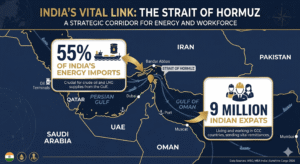
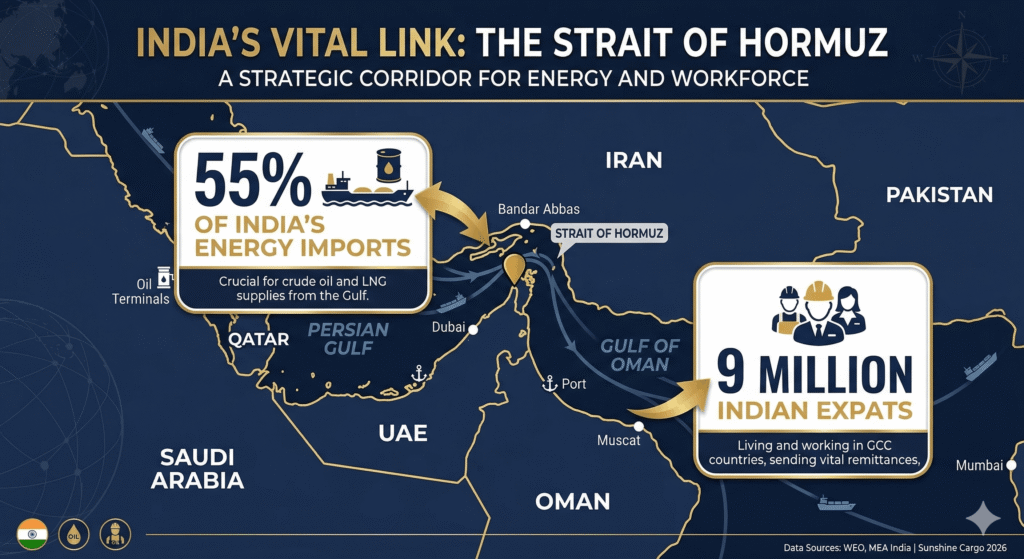
For India, the stakes are not just diplomatic; they are deeply personal and economic, involving the safety of 9 million citizens and the stability of its energy lifeline.
In this crisis, the facts point to a massive shift in how New Delhi manages its “balancing act” in West Asia.
Impact of Middle East Conflict on Indian Energy Security
India is the world’s third-largest oil consumer, importing more than 88% of the crude it processes to keep its economy moving.
The effective closure of the Strait of Hormuz has sent Brent crude prices surging, at one point reaching $120 a barrel as insurance risks for tankers skyrocket.
According to Harsh V. Pant of the Observer Research Foundation, “India’s energy security will be impacted significantly, as it relies on the Middle East for a substantial portion of its energy requirements.”
To combat potential shortages, the Indian government has invoked emergency powers to prevent the hoarding of LPG cylinders and is exploring increased imports from Russia and the US.
Safety of Indian Expats in Gulf Countries During Iran-Israel War
There are approximately 9.1 million Indian nationals living and working in GCC countries like the UAE, Saudi Arabia, and Qatar.
These workers contribute nearly $50 billion in annual remittances, a vital pillar that supports the “economic robustness of the Indian economy.”
The physical safety of these citizens is now a primary concern, as Iranian retaliatory strikes have reached major Gulf hubs, including Dubai and Abu Dhabi.
Former Ambassador Talmiz Ahmad warns that evacuating 9 million people in a war zone is a “logistical nightmare” that no country can fully execute.
New Customs Rules for Indian Exporters Amid Strait of Hormuz Closure
The Central Board of Indirect Taxes and Customs (CBIC) has recently eased regulations to help exporters dealing with cargo stuck due to the Iran-Israel war.
New measures allow for “Back to Town” clearance, enabling stranded cargo to be returned to the domestic market without heavy procedural penalties.
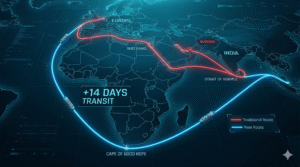
Shipping lines are now permitted to file fresh arrival manifests at Indian ports if vessels are forced to reroute away from the conflict zone.
To minimize delays, exporters are encouraged to check Bill of Entry status on ICEGATE frequently to ensure real-time tracking of returned shipments.
Additionally, CONCOR has offered 30 days of additional free storage and a 30% discount on plug-in charges for reefer containers to support MSMEs.
Understanding demurrage and detention charges is now critical for businesses looking to avoid massive overheads during these logistical disruptions.
Is India Shifting its Foreign Policy Toward Israel and the US?
For decades, India maintained a strict “neutrality” between Iran and Israel, but recent events suggest a subtle yet significant strategic tilt.
While Prime Minister Modi has “strongly condemned” attacks on the UAE, India has remained silent on the killing of Iran’s Supreme Leader.
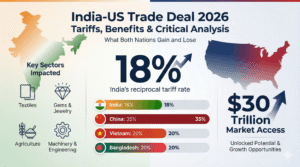
This shift comes at a time when India is strengthening western ties, specifically through the India-US Trade Deal 2026 and ongoing India-EU FTA negotiations.
“India’s interests have been dominated by the Arab world and the relationship with Israel rather than with Iran,” notes Harsh V. Pant, reflecting the shift in ground realities.
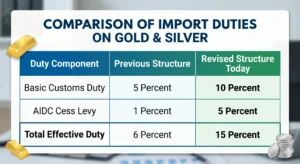
Recent Union Budget 2026 customs duty changes also reflect a move toward deeper integration with Western markets and manufacturing partners.
How the India-Iran Conflict Affects Trade and Remittances
The disruption of the Strait of Hormuz doesn’t just stop oil; it threatens the flow of $50 billion that sustains nearly 40 to 50 million people back in India.
If the conflict persists, Indian refiners are expected to diversify further, looking toward Venezuela and Russia to fill the gap.
Exporters are also looking at different types of transport in customs to find safer, albeit more expensive, air routes for high-value cargo.
With new GST rates notifications and fluctuating duty structures, keeping trade fluid requires constant inter-ministerial coordination.
As the situation evolves, India’s ability to protect its supply chains while maintaining its diplomatic standing will be the ultimate test of its “Viksit Bharat” ambitions.