Published by: Akash Gupta, Sunshine Cargo Services
Publication Date & Location: 10th February, 2026 ; Kolkata, India
Last Updated: 10th February, 2026

The India-United States Bilateral Trade Agreement, announced in February 2026, represents one of the most significant economic agreements in recent bilateral trade history. This interim framework agreement unlocks preferential access for Indian goods to a $30 trillion U.S. market while establishing reciprocal commitments that reshape trade dynamics between the world’s largest economy and its fastest-growing major economy.

What is the India-US Trade Deal?

The India-US Trade Deal is an interim bilateral agreement that reduces tariff barriers between the two countries and establishes a framework for enhanced market access. Under this agreement, India receives a preferential reciprocal tariff rate of 18% on most goods entering the United States, down from previous rates as high as 50%. The U.S. eliminates tariffs entirely on specific categories including generic pharmaceuticals, gems and diamonds, and aircraft parts. In exchange, India eliminates or reduces tariffs on U.S. industrial goods and agricultural products including tree nuts, processed fruits, soybean oil, wine, and spirits.

This framework serves as a foundation for the broader Bilateral Trade Agreement (BTA) currently under negotiation. The deal covers approximately $86.35 billion in current Indian exports to the United States and establishes rules of origin, addresses non-tariff barriers, and commits both nations to digital trade cooperation.

How the Tariff Restructuring Works

Major Relief on Reciprocal Tariffs

Of India’s $86.35 billion in exports to the United States in 2024, $40.96 billion were subject to reciprocal tariffs. The agreement restructures these as follows:

  • $30.94 billion in exports see tariffs reduced from 50% to 18%
  • $10.03 billion in exports receive zero-tariff access (reduced from 50%)
  • $1.04 billion under exemption category maintains zero reciprocal duty
  • $28.30 billion under Section 232 provisions gains zero additional duty access

This creates substantial cost advantages for Indian exporters across textiles, leather, machinery, and consumer goods sectors.

Competitive Positioning Against Other Exporters

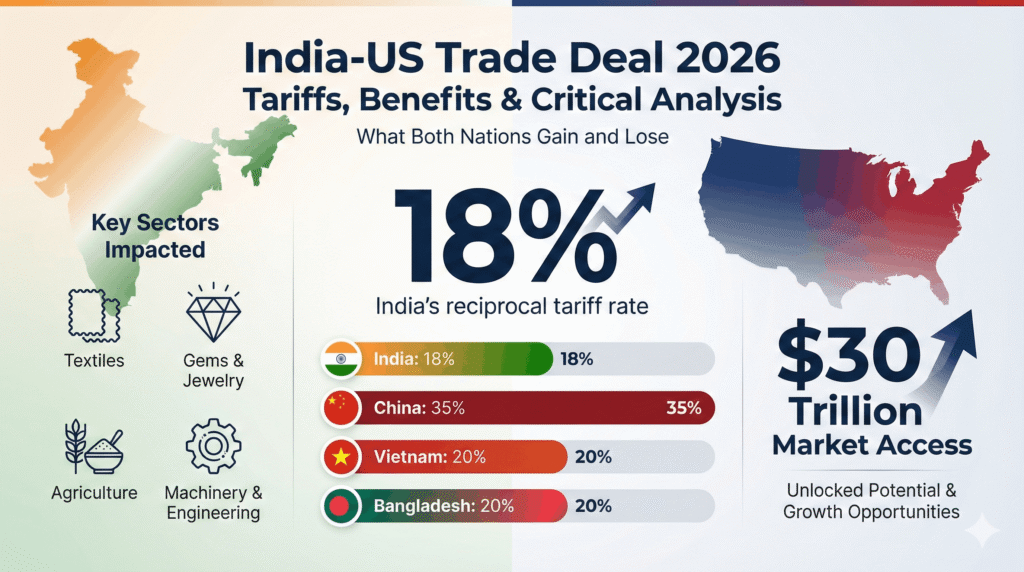
The agreement creates differential tariff treatment favoring India over competing Asian suppliers. While Indian goods face an 18% reciprocal tariff, competitors face higher rates:

  • China: 35%
  • Vietnam: 20%
  • Bangladesh: 20%
  • Malaysia, Indonesia, Philippines, Cambodia, Thailand: 19%

This 1-17 percentage point advantage significantly enhances India’s price competitiveness in the U.S. market, particularly in labor-intensive manufacturing sectors where margins are sensitive to tariff differentials.

Suggested Read: The India-EU Free Trade Agreement (FTA) 2026

What India Gains from the India US Trade Deal

Textile and Apparel Sector Benefits

Tariffs on textile exports drop from 50% to 18%, with silk receiving 0% duty access. This opens enhanced opportunities in a U.S. market valued at $113 billion. Major categories benefiting include readymade garments, carpets, man-made and cotton textiles, bedspreads, yarn, baby clothing, bed linen, blankets, and gloves.

Given India’s substantial textile production capacity and competitive labor costs, this tariff reduction positions Indian manufacturers to capture market share from competitors facing higher duties. The textile sector employs millions across India’s production clusters, making this particularly significant for employment generation.

Leather and Footwear Market Access

Tariff reductions from 50% to 18% provide improved access to a $42 billion U.S. leather and footwear market. India’s labor-intensive leather industry, concentrated in states like Tamil Nadu and Uttar Pradesh, stands to benefit substantially. The agreement covers finished leather, leather footwear, and footwear components.

This positions India as a preferred supplier against competitors like Vietnam and China, which face higher tariff barriers in the U.S. market.

Gems and Jewelry Sector Advantages

The agreement reduces tariffs from 50% to 18% on gems and jewelry, providing access to a $61 billion U.S. market. Additionally, 0% duty access applies to diamonds, platinum, and coins covering a $29 billion market segment.

India dominates global diamond cutting and polishing, processing approximately 90% of the world’s diamonds by volume. Zero-duty access for cut and polished diamonds, lab-grown diamonds, and colored gemstones strengthens India’s competitive position in this high-value sector.

Machinery and Industrial Exports

Machinery tariffs drop from 50% to 18%, opening opportunities in a $477 billion U.S. market. India’s current machinery exports to the U.S. stand at $2.35 billion, indicating substantial growth potential. This supports India’s manufacturing ambitions and efforts to expand value-added industrial exports.

Agricultural Export Opportunities

The United States grants zero additional duty access to $1.36 billion in Indian agricultural exports. Beneficiary products include:

  • Spices (India saw 88% growth in spice exports in 2024-25)
  • Tea and coffee extracts
  • Coconut and coconut oil
  • Tree nuts (areca, Brazil nuts, cashews, chestnuts)
  • Fruits (avocados, bananas, guavas, mangoes, kiwis, papayas, pineapples)
  • Mushrooms
  • Processed products (fruit pulp, juices, jams)
  • Bakery products
  • Sesame and poppy seeds

Within this, $1.035 billion receives assured zero reciprocal tariff treatment, providing stability for Indian farmers and agricultural exporters. India maintains a $1.3 billion agricultural trade surplus with the United States ($3.4 billion in exports versus $2.1 billion in imports).

Industrial Exports with Zero-Duty Access

The agreement secures zero additional duty for $38 billion in industrial exports under Section 232 provisions and other categories:

  • Aircraft parts
  • Generic drugs and pharmaceutical ingredients
  • Elementary auto parts
  • Gems and diamonds
  • Clocks and watches
  • Essential oils
  • Home décor items (chandeliers, illuminated signs)
  • Inorganic chemicals
  • Instruments and apparatus
  • Minerals and natural resources
  • Natural rubber

Home Décor and Consumer Goods

Tariffs on home décor exports reduce from 50% to 18%, accessing a $52 billion U.S. market. Products include wood furniture, pillows, cushions, quilts, non-electrical lamps, and furnishing products. Additionally, 0% duty access covers $13 billion in products including seats, chandeliers, and illuminated signs.

Toys and MSMEs

Toy export tariffs drop from 50% to 18%, providing access to an $18 billion U.S. market. This creates opportunities for domestic manufacturers, particularly MSMEs, to scale production and integrate into global supply chains.

What India Concedes in the Trade Deal

Industrial Goods Market Opening

India eliminates or reduces tariffs on U.S. industrial goods across multiple categories. Market access is structured through immediate elimination, phased reduction over up to ten years, and quota-based access depending on product sensitivity.

Sensitive sectors receive calibrated safeguards:

  • Automobiles: Liberalized through quota and duty reduction combinations
  • Medical devices: Long, staggered phasing schedules
  • Precious metals: Quota-based tariff lowering

Agricultural Product Imports

India provides market access to select U.S. agricultural products while maintaining protections for sensitive sectors:

Liberalized categories include:

  • Tree nuts (in-shell almonds, walnuts, pistachios under tariff rate quotas)
  • Fresh and processed fruits (berries)
  • Niche oils
  • Wine and spirits
  • Soybean oil
  • Dried distillers’ grains (DDGs)
  • Red sorghum for animal feed
  • Select processed foods

Phased elimination (up to 10 years) applies to:

  • Albumins
  • Certain oils (coconut oil, castor oil, cotton seed oil)
  • Modified starches
  • Plant materials used in food processing

Immediate elimination applies only to:

  • Non-sensitive products already liberalized under other FTAs

Consumer-Oriented Imports

The agreement enables calibrated access to consumer products that supplement domestic supply:

  • Tree nuts
  • Berries and processed fruits
  • Premium beverages
  • Select pet food products
  • Frozen fish (salmon, cod, Alaska pollock)
  • Yeast, margarine, abalone

Intermediate Goods and Technology Inputs

India facilitates access to critical inputs for manufacturing:

  • Rough diamonds and precious stones
  • Specialty chemicals for pharmaceuticals
  • Active pharmaceutical ingredients
  • Semiconductor wafers and fabrication inputs
  • Electronics components (IC substrates, sensors, microcontrollers)
  • Carbon fibers
  • Industrial enzymes
  • Aerospace components
  • Battery materials (lithium compounds, cathode materials)
  • Fertilizer inputs (phosphate rock, potash)

High-Technology Imports

The agreement supports technology advancement by facilitating access to:

  • Advanced medical devices (diagnostic imaging, surgical robotics)
  • AI chips and high-performance processors
  • Semiconductor manufacturing equipment
  • Cloud computing infrastructure hardware
  • Telecom and ICT network equipment
  • Clean energy technologies
  • Biotechnology research equipment
  • Data center infrastructure equipment

Non-Tariff Commitments

India commits to addressing several non-tariff barriers:

Medical devices: Remove long-standing barriers to U.S. medical device trade

ICT goods: Eliminate restrictive import licensing procedures that delay market access or impose quantitative restrictions

Standards alignment: Determine within six months whether U.S.-developed or international standards are acceptable for U.S. exports in identified sectors

Agricultural products: Address long-standing non-tariff barriers to U.S. food and agricultural products

Conformity assessments: Discuss standards and conformity assessment procedures for mutually agreed sectors

Purchase Commitments

India intends to purchase $500 billion in U.S. goods over five years:

Suggested Read: Union Budget 2026 – Complete Customs Overhaul Full Analysis

What the United States Gains from the US India Trade Deal
Expanded Agricultural Export Market

U.S. agricultural producers gain preferential or duty-free access to India’s large and growing consumer market. Key beneficiaries include:

  • Tree nut producers (almonds, walnuts, pistachios)
  • Fruit growers (berries, processed fruits)
  • Wine and spirits producers
  • Soybean oil exporters
  • Animal feed producers (DDGs, red sorghum)

India’s growing middle class and rising incomes create expanding demand for premium food products, positioning U.S. agricultural exporters for long-term growth.

Industrial Goods Market Access

U.S. industrial exporters benefit from India’s tariff eliminations and reductions across multiple categories. This includes machinery, equipment, chemicals, and manufactured components where U.S. firms maintain technological advantages.

Medical Device and Pharmaceutical Market

The agreement addresses long-standing barriers to U.S. medical device exports, potentially unlocking substantial market opportunities in India’s expanding healthcare sector. India’s healthcare infrastructure investment creates demand for advanced diagnostic and surgical equipment where U.S. manufacturers lead globally.

Technology Hardware Exports

India’s commitment to significantly increase technology product trade, including GPUs and data center goods, benefits U.S. semiconductor and hardware manufacturers. India’s digital infrastructure expansion and data center growth create sustained demand for high-performance computing equipment.

Energy Exports

U.S. energy producers gain a major customer through India’s commitment to purchase U.S. energy products as part of the $500 billion procurement package. This includes liquefied natural gas (LNG), crude oil, and refined petroleum products.

Aircraft and Aerospace

Zero-tariff treatment for aircraft parts from India under Section 232 provisions facilitates aerospace supply chain integration. Simultaneously, India’s purchase commitments for aircraft and aircraft parts strengthen demand for U.S. aerospace manufacturers.

Strategic Economic Alignment

The agreement advances U.S. strategic objectives by strengthening economic ties with India as a counterweight to China in the Indo-Pacific region. Enhanced supply chain cooperation and alignment on non-market economy policies support broader U.S. strategic interests.

Digital Trade Framework

Both countries commit to addressing barriers to digital trade and establishing robust digital trade rules as part of the broader BTA. Given U.S. leadership in digital services, cloud computing, and software, a structured digital trade framework reduces regulatory uncertainty and facilitates cross-border service delivery.

What the United States Concedes in the Trade Deal


Reduced Tariff Revenue

The U.S. grants preferential 18% reciprocal tariff rates and zero-duty access on substantial Indian export volumes. This represents forgone tariff revenue on approximately $86 billion in current Indian exports, with projected growth following preferential treatment.

Competitive Pressure on Domestic Industries

Lower tariffs on Indian textiles, apparel, leather goods, and footwear increase competitive pressure on U.S. domestic manufacturers in these sectors. While U.S. production in these labor-intensive industries has declined significantly, remaining producers and workers face additional import competition.

Market Share Shifts

Preferential treatment for India creates disadvantages for other U.S. trading partners that do not receive similar terms. This may shift sourcing patterns toward India and away from other suppliers, potentially complicating U.S. relationships with other Asian trade partners.

Limits on Trade Policy Flexibility

The agreement’s reciprocal commitments constrain U.S. flexibility to adjust tariffs on Indian goods unilaterally. The provision that either country may modify commitments if the other changes agreed tariffs provides some protection, but nevertheless represents a negotiated constraint.

Technology Transfer and Spillover Risks

Increased exports of advanced semiconductors, AI chips, and high-performance computing equipment to India create potential technology spillover risks. While the agreement preserves national security safeguards, expanded technology trade always carries some risk of knowledge diffusion.

Why the India US Trade Deal is Good for India


Price Competitiveness Enhancement

The differential tariff structure—18% for India versus 19-35% for competitors—provides a measurable competitive advantage in price-sensitive markets. For products where all other factors are comparable, this 1-17 percentage point difference directly impacts market share capture.

Employment Generation Potential

Labor-intensive sectors receiving preferential access—textiles, leather, footwear, toys, home décor—are significant employment generators. Enhanced U.S. market access supports job creation across manufacturing clusters in states like Tamil Nadu, Uttar Pradesh, Gujarat, and Maharashtra.

MSME Sector Opportunities

Small and medium enterprises dominate several beneficiary sectors. Reduced tariffs lower entry barriers for MSMEs seeking to export to the U.S. market, supporting India’s broader MSME development objectives.

Agricultural Income Stability

Zero-duty access for $1.36 billion in agricultural exports, with assured zero reciprocal tariff for $1.035 billion, provides income stability for farmers producing export-oriented crops like spices, tea, coffee, and tree nuts. This is particularly valuable given agricultural income volatility.

Protection of Sensitive Sectors

The agreement excludes highly sensitive agricultural products from liberalization commitments. Full protection applies to:

  • Dairy products (milk, cream, yogurt, butter, ghee, paneer, cheese)
  • Meat and poultry
  • Major cereals (rice, wheat, corn, millets)
  • Pulses (green peas, chickpeas, mung beans)
  • Oilseeds
  • Fruits (bananas, strawberries, cherries, citrus)
  • Sugar
  • Ethanol for fuel
  • Tobacco

This safeguards millions of Indian farmers from direct import competition in sectors where they lack competitive advantages.

Technology Access for Development

The agreement facilitates access to advanced technologies critical for India’s digital and industrial transformation:

  • Semiconductor manufacturing equipment supports domestic chip production ambitions
  • AI chips and high-performance processors enable data center expansion
  • Advanced medical devices improve healthcare delivery
  • Clean energy technologies advance sustainability objectives
  • Precision agriculture technology enhances farm productivity

Digital Trade Framework Benefits

As the world’s 5th largest exporter of digitally delivered services ($0.28 trillion in 2024, growing 10.3% year-on-year), India benefits substantially from a structured digital trade framework with the world’s largest digital services importer. Reduced regulatory uncertainty and lower compliance friction facilitate cross-border service delivery for India’s IT services, business process management, and digital solutions sectors.

Quality Standards Alignment

Recognition of conformity assessments reduces double-testing requirements, saving exporters time and costs. Alignment with international standards in machinery, medical devices, and electronics supports deeper integration into global value chains beyond just the U.S. market, including the European Union, United Kingdom, and Japan.

Supply Chain Integration

Preferential treatment positions India as a reliable alternative to China in U.S. supply chains. This “China plus one” dynamic creates long-term strategic advantages as companies diversify sourcing beyond China.

Why the Trade Deal May Be Problematic for India


Import Competition in Manufacturing

Liberalization of automobile imports through quota and duty reduction mechanisms creates competitive pressure on India’s domestic automotive sector. While phased implementation provides adjustment time, increased competition may challenge Indian manufacturers, particularly in segments where U.S. or imported vehicles offer superior technology or brand appeal.

Medical Device Industry Impact

Addressing barriers to U.S. medical device imports, combined with long phasing schedules for tariff reductions, creates competitive challenges for India’s emerging medical device manufacturing sector. Increased imports may limit domestic industry growth unless Indian manufacturers successfully compete on quality and innovation.

Agricultural Import Risks

While sensitive products remain protected, liberalized categories create some import exposure:

  • Tree nuts under tariff rate quotas may pressure domestic producers
  • Wine and spirits imports compete with domestic alcohol industries
  • Soybean oil imports may affect domestic oilseed processors
  • Processed foods compete with domestic food processing industries

Phased elimination periods provide adjustment time, but import competition nevertheless creates uncertainty for affected producers.

Small Farmer Vulnerability

Even with protections for major crops, farmers producing marginally competitive products face risks. Limited-quantity imports under tariff rate quotas can create local market disruptions, particularly if import timing coincides with domestic harvest periods.

Non-Tariff Commitment Costs

India’s commitment to accept U.S. or international standards within six months in identified sectors may require costly regulatory changes. Industries accustomed to India-specific standards may face compliance costs to align with international requirements.

Technology Dependence Risks

Increased reliance on U.S. technology inputs—semiconductors, AI chips, cloud infrastructure—creates supply chain dependencies. Any future disruption in U.S.-India relations or U.S. export control policy changes could impact India’s digital infrastructure and technology sectors.

Fiscal Impact of Tariff Reductions

Eliminating or reducing tariffs on U.S. imports reduces government tariff revenue. While exact figures depend on import volumes, substantial liberalization across industrial and agricultural categories represents measurable revenue forgone.

Adjustment Costs for Domestic Industries

Industries facing increased import competition require adjustment support. Workers in sectors like automobiles, medical devices, and processed foods may need retraining or relocation support as import competition intensifies.

Trade Deficit Implications

The $500 billion procurement commitment over five years, combined with liberalized market access for U.S. goods, may widen India’s trade deficit. While India gains export opportunities, the agreement’s two-way nature means increased imports as well. Net trade balance effects depend on relative growth rates of exports versus imports.

Suggested Read: The India-EU Free Trade Agreement (FTA) 2026

Why the US India Trade Deal is Good for the United States

Agricultural Market Expansion

The agreement provides U.S. agricultural exporters with preferential access to a market of 1.4 billion people with rising incomes. India’s growing middle class creates sustained demand growth for premium food products, tree nuts, fruits, wine, and processed foods where U.S. producers excel.

Strategic Diversification from China

Strengthening economic ties with India advances U.S. strategic objectives in the Indo-Pacific. The agreement’s supply chain cooperation and alignment on non-market economy policies support U.S. efforts to reduce economic dependence on China and build alternative supply chains.

Technology Hardware Demand

India’s digital infrastructure expansion creates substantial demand for U.S. technology hardware. The commitment to significantly increase technology product trade, particularly GPUs and data center equipment, benefits U.S. semiconductor manufacturers during a period of intense global competition in chip production.

Energy Export Growth

U.S. energy producers gain a major long-term customer. India’s energy import requirements—driven by economic growth and limited domestic fossil fuel resources—create sustained demand for U.S. LNG, crude oil, and refined products.

Aerospace Industry Benefits

Zero-tariff treatment for aircraft parts supports integrated aerospace supply chains. Combined with purchase commitments for aircraft and components, this strengthens U.S. aerospace manufacturers’ position in one of the world’s fastest-growing aviation markets.

Removal of Non-Tariff Barriers

India’s commitments to address long-standing barriers in medical devices, ICT goods, and agricultural products remove obstacles that have hindered U.S. exporters for years. Eliminating restrictive import licensing and accepting international standards reduces costs and delays for U.S. companies.

Digital Trade Framework Advantages

As the world’s largest exporter and importer of digitally delivered services, the U.S. benefits from structured digital trade rules. A framework that reduces regulatory barriers and facilitates cross-border data flows supports U.S. technology companies operating in India’s large and growing digital market.

Intellectual Property and Standards

Alignment with U.S.-developed or international standards in key sectors creates long-term advantages for U.S. exporters. Once standards are harmonized, U.S. products designed to those standards gain streamlined market access.

Suggested Read: The India-EU Free Trade Agreement (FTA) 2026

Why the Trade Deal May Be Problematic for the United States

Domestic Industry Competitive Pressure

Reduced tariffs on Indian textiles, apparel, leather, and footwear increase competitive pressure on remaining U.S. manufacturers in these sectors. While U.S. production has already declined substantially, workers and communities dependent on these industries face additional challenges.

Lost Tariff Revenue

Granting preferential 18% rates and zero-duty access on $86 billion in current Indian exports (with growth expected) represents substantial forgone tariff revenue. At a time of fiscal pressures, this revenue loss must be weighed against broader economic and strategic benefits.

Complexity and Enforcement Challenges

The agreement’s numerous provisions—rules of origin, tariff rate quotas, phased implementation schedules, standards alignment commitments—create administrative complexity. Effective enforcement requires robust monitoring and dispute resolution mechanisms.

Technology Transfer Concerns

Expanded exports of advanced semiconductors, AI chips, and high-performance computing equipment create technology spillover risks. While national security safeguards exist, increased technology trade always carries some risk of knowledge diffusion to competitors or potential adversaries.

Trade Relationship Asymmetries

India’s $500 billion procurement commitment is an intent, not a binding obligation. Actual purchases depend on commercial decisions, competitive pricing, and India’s economic conditions. If procurement falls short, the U.S. may perceive asymmetry in benefits.

Potential WTO Compliance Questions

Preferential bilateral tariff reductions outside a comprehensive free trade agreement may face questions about WTO compliance, particularly regarding most-favored-nation principles. While both countries maintain WTO membership, bilateral preferential treatment creates potential complications.

Limited Services Market Access

The agreement focuses primarily on goods trade with digital trade commitments deferred to the broader BTA negotiations. U.S. service exporters in sectors like banking, insurance, legal services, and professional services do not receive substantial new market access in this interim agreement.

Opportunity Costs with Other Partners

Resources and negotiating capital invested in the India agreement represent opportunity costs. Deeper agreements with other trading partners might yield greater economic benefits, depending on comparative market sizes, growth rates, and complementarities.

India-US Trade Deal vs Competing Economies

India US Trade Deal Impact on China

The agreement directly challenges China’s position in the U.S. market. With China facing 35% tariffs compared to India’s 18%, Indian exporters gain a 17 percentage point advantage. This is particularly significant in:

  • Textiles and apparel
  • Leather and footwear
  • Consumer goods
  • Home décor
  • Toys
  • Generic pharmaceuticals

The agreement accelerates the “China plus one” diversification strategy pursued by multinational companies seeking supply chain resilience.

India US Trade Deal Impact on Vietnam and Bangladesh

Vietnam and Bangladesh, major textile and apparel exporters facing 20% U.S. tariffs, find themselves at a disadvantage against India’s 18% rate. While the difference is smaller than with China, it nevertheless impacts competitiveness in price-sensitive markets.

Bangladesh’s ready-made garment sector, heavily dependent on U.S. market access, faces particular pressure. Vietnam’s diversified export base provides some insulation, but its textile and footwear sectors compete directly with India.

India US Trade Deal Impact on ASEAN Nations

Malaysia, Indonesia, Philippines, Cambodia, and Thailand all face 19% tariffs—one percentage point higher than India. While seemingly modest, in high-volume, low-margin manufacturing sectors, this difference affects competitive positioning.

The agreement may prompt ASEAN nations to seek their own preferential arrangements with the United States to restore competitive parity.

Impact on Latin American Suppliers

Mexico and Central American countries with existing USMCA or CAFTA-DR agreements maintain zero or very low tariff access to the U.S. market. The India agreement does not directly disadvantage them, but India’s emergence as a preferred supplier for certain categories may shift sourcing patterns away from Latin America in products where India offers superior cost structures despite the 18% tariff.

Long-Term Strategic Implications Of India US Trade Deal

Geopolitical Realignment

The agreement represents significant geopolitical realignment in the Indo-Pacific. By strengthening economic interdependence, the U.S. and India deepen strategic partnership beyond defense and diplomatic cooperation. This creates a counterweight to China’s economic influence in Asia.

Supply Chain Resilience

The agreement advances both countries’ supply chain resilience objectives. The U.S. reduces dependence on China-centered supply chains while India integrates more deeply into U.S.-led global value chains. This mutual reinforcement supports long-term economic security for both nations.

Technology Cooperation Framework

Beyond immediate trade benefits, the agreement establishes frameworks for technology cooperation in semiconductors, artificial intelligence, quantum computing, and biotechnology. This positions both countries for joint leadership in emerging technology sectors.

Digital Economy Integration

With India as the 5th largest digital services exporter and the U.S. as the largest importer, structured digital trade rules create a foundation for deeper digital economy integration. This extends beyond the bilateral relationship to potentially influence global digital trade governance.

Climate and Clean Energy

The agreement facilitates trade in clean energy technologies, supporting both countries’ climate objectives. U.S. clean energy technology exports to India and India’s renewable energy manufacturing growth create opportunities for climate-aligned economic cooperation.

Negotiating Template

The agreement may serve as a template for U.S. trade relationships with other partners. Its structure—preferential reciprocal tariffs, sectoral safeguards, phased implementation, and technology cooperation—could influence future U.S. bilateral trade frameworks.

Frequently Asked Questions

What is the India-US trade deal tariff rate?

The India-US trade deal establishes an 18% reciprocal tariff rate for most Indian goods entering the United States, reduced from previous rates as high as 50%. Additionally, zero-duty access applies to specific categories including generic pharmaceuticals, gems and diamonds, aircraft parts, and $1.36 billion in agricultural exports. India receives preferential treatment compared to competitors: China faces 35%, Vietnam and Bangladesh 20%, and other Asian nations 19%.

How much trade happens between India and the United States?

India’s total exports to the United States stood at $86.35 billion in 2024. India maintains an agricultural trade surplus of $1.3 billion with the U.S., exporting $3.4 billion in agricultural products while importing $2.1 billion. In digital services, India exported $0.28 trillion in digitally delivered services globally in 2024, with the United States being a major destination. The agreement commits India to purchase $500 billion in U.S. goods over five years.

What agricultural products does India get duty-free access for?

India receives zero additional U.S. duty access for $1.36 billion in agricultural exports, including spices, tea and coffee extracts, coconut and coconut oil, tree nuts (areca nuts, cashews, chestnuts), fruits (avocados, bananas, guavas, mangoes, papayas, pineapples), mushrooms, sesame and poppy seeds, bakery products, and processed products like fruit pulp and juices. Within this, $1.035 billion receives assured zero reciprocal tariff treatment for stability.

What sensitive agricultural sectors does India protect?

India fully protects highly sensitive agricultural sectors including all dairy products (milk, cream, butter, ghee, paneer, cheese), meat and poultry, major cereals (rice, wheat, corn, millets like jawar and bajra), pulses (green peas, chickpeas, mung beans), oilseeds, select fruits (bananas, strawberries, cherries, citrus), sugar, groundnuts, honey, non-alcoholic beverages, flour, essential oils, ethanol for fuel, and tobacco. These receive no tariff concessions and remain fully protected from U.S. imports.

How does the deal benefit Indian textile exports?

Indian textile tariffs drop from 50% to 18%, with silk receiving 0% duty access, opening opportunities in a $113 billion U.S. market. This covers readymade garments, carpets, cotton and man-made textiles, bedspreads, yarn, baby clothing, bed linen, blankets, and gloves. The 18% rate provides competitive advantages over China (35%), Vietnam (20%), and Bangladesh (20%), potentially supporting significant job creation across India’s textile production clusters.

What technology does India gain access to through this deal?

India gains facilitated access to advanced semiconductors, AI chips and high-performance processors, semiconductor manufacturing equipment, cloud computing infrastructure, telecom and ICT equipment, advanced medical devices including diagnostic imaging and surgical robotics, clean energy technologies, biotechnology research equipment, quantum computing components, and data center infrastructure equipment. This supports India’s digital transformation while maintaining national security safeguards.

Does the deal harm Indian farmers?

The agreement protects Indian farmers by excluding all highly sensitive products—dairy, meat, major cereals, pulses, oilseeds, and key fruits—from liberalization. Products that receive limited access use tariff rate quotas (almonds, walnuts, pistachios) or long phase-in periods (up to 10 years) providing adjustment time. India maintains its $1.3 billion agricultural trade surplus with the U.S. and gains zero-duty access for $1.36 billion in exports, primarily benefiting spice, tea, coffee, and specialty crop farmers.

Updated for 2026: This analysis reflects the India-US Bilateral Trade Agreement framework announced in February 2026 and incorporates official government data on trade volumes, tariff structures, and sector-specific commitments as released by both countries’ commerce ministries.

Suggested Read: Union Budget 2026 – Complete Customs Overhaul Full Analysis
sunshine cargo services
private limited

Head Office Address:
Marshall House, Room 574, 33/1, N.S. Road/25, Strand Road, Kolkata West Bengal 700001

Contact:
Deepak Kumar:
+91-98300-66760
Manish Kumar:
+91-98363-29801

Email:
su************@***oo.com

Working Hours:
Monday-Friday: 10:00 AM to 18:00 PM
Saturday: 10:00 AM to 14:00 PM
Closed on Sundays and Indian Government Holidays.

Service Offices:
Raxaul, Bihar, India
Jogbani, Bihar, India

All Rights Reserved by Sunshine Cargo Services Private Limited.

Developed by FresioMedia.

Scroll to Top