Published By: Akash Gupta, Sunshine Cargo Services
Publication Date:
3rd February, 2026

Latest: Read about the changes in Customs Duties in Budget 2026. Click Here.


What Exactly Is the India-US Trade Deal 2026?


Quick Answer: It’s a bilateral agreement where the US slashes import tariffs on Indian goods and India promises to open its markets wider to American products.

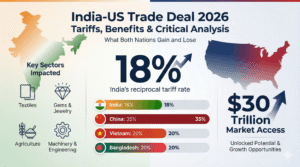
On the evening of February 2, 2026, US President Donald Trump and Indian Prime Minister Narendra Modi had a phone call that changed the trade landscape overnight. Trump announced on Truth Social that, out of “friendship and respect” for Modi, the US would immediately cut its reciprocal tariff on Indian goods from 25% to 18%. The additional 25% penalty tariff — imposed because of India’s purchases of Russian oil — was also removed, bringing the total effective rate down from a whopping 50% to just 18%.

In return, India committed to lowering its own tariffs and non-tariff barriers on American goods, with the eventual goal of bringing them to zero. Modi welcomed the move warmly, thanking Trump “on behalf of the 1.4 billion people of India.”

⚡ Why This Matters

Before this deal, India was paying the highest tariff rate in the world on exports to the US — tied with Brazil at 50%. That was crushing Indian exporters in textiles, jewellery, auto parts, and more. This deal brings India back in line with its Asian neighbours.

How Did We Get Here? A Quick Timeline of the Tensions Between India & US


Quick Answer: It’s been a rollercoaster year — tariffs went up, talks stalled, and relations hit a rough patch before this breakthrough.

The road to this deal was anything but smooth. Here’s how things unfolded:

When

What Happened

April 2, 2025

US imposed a 26% “reciprocal tariff” on Indian imports under Trump’s global “Liberation Day” tariff actions.

April 10, 2025

Trump paused the tariffs for 90 days, keeping a baseline 10% duty on all imports.

July 31, 2025

Trump announced a 25% tariff on all Indian goods, plus a threat of a penalty if India kept buying Russian oil.

August 7, 2025

Tariffs jumped to 50% — the highest on any US trade partner — after India continued Russian oil purchases.

Mid-2025

Trade talks stalled. Trump focused on deals with Japan and the EU, while India was sidelined.

Late 2025

India began slowing Russian oil imports. Diplomatic back-channels reopened.

Feb 2, 2026

Modi-Trump phone call leads to the tariff cut announcement. The deal is born.

Have you read about the ‘Mother Of All Deals?’ Click here to read about India-EU FTA.

What Does India Actually Have to Give Up?


Quick Answer: India is on the table for some big concessions — tariff reductions, stopping Russian oil buys, and a massive purchasing commitment.

Trump’s side of the story is pretty detailed. According to his Truth Social post, India has agreed to:

  1. Reduce tariffs and non-tariff barriers to zero. This is a bold claim. India has historically been one of the more protectionist economies in the world. Exactly which product categories will see barriers drop to zero — and on what timeline — hasn’t been officially confirmed by New Delhi yet.
  2. Stop buying Russian oil. A White House official confirmed that India needs to “cease, not just reduce” its Russian oil purchases for the penalty tariff to stay off. India imports roughly 90% of its oil needs, and cheap Russian crude had been a lifeline since 2022. However, Indian refiners had already started cutting back — Reliance Industries, one of India’s biggest, said in January 2026 it would not receive any Russian oil that month.
  3. Buy over $500 billion worth of US products. Trump claimed Modi pledged to purchase American energy, technology, agriculture, coal, and other goods worth more than $500 billion. To put that in perspective, India’s current annual imports from the US are under $50 billion. So this figure, if real, would play out over many years across multiple sectors.

⚠️ A Word of Caution

India’s government has not publicly confirmed many of Trump’s claims. PM Modi’s response focused on the tariff cut and did not mention Russian oil or the $500 billion figure. Until a joint statement or negotiated text is released, some of these commitments remain unverified.

What Does the US Get Out of This India-US Trade Deal?

Quick Answer: The US gains a massive new market for its farms, energy, and tech — plus a geopolitical win by pulling India away from Russia.

For Washington, this deal is a big tick in several boxes:

Agriculture: US Agriculture Secretary Brooke Rollins called this an “America First” victory. The US has a $1.3 billion agricultural trade deficit with India, and with 1.4 billion mouths to feed, India is one of the most attractive emerging markets for American farm products — grains, dairy, and processed foods chief among them.

Energy: India shifting away from Russian oil and toward US crude (and possibly Venezuelan oil) is a strategic goldmine for Washington. It strengthens US energy exports and weakens Moscow’s revenue stream at the same time.

Technology: The deal opens doors for deeper cooperation in semiconductors, AI, and cybersecurity. US tech companies see India as one of the fastest-growing digital markets in the world.

How Does India’s 18% Tariff Compare to Other Countries?


Quick Answer: At 18%, India is now roughly on par with Vietnam and Thailand, and well below China, Brazil, and South Africa.

Context matters. Here’s where India now sits on the global tariff map:

Country / Region

US Tariff Rate

United Kingdom

10%

European Union

15%

Japan

15%

South Korea

15%

Switzerland

15%

🇮🇳 India (after deal)

18%

Malaysia

19%

Cambodia

19%

Thailand

19%

Vietnam

20%

South Africa

30%

China

37%

Myanmar

40%

Laos

40%

Brazil

50%

India is now competitive with its Southeast Asian rivals. However, trade experts have pointed out that many of India’s neighbours also enjoy a GSP (Generalised System of Preferences) discount of around 5%, which the US withdrew from India back in 2019. So the playing field is close — but not perfectly level yet.

Which Indian Industries Will Benefit the Most Out Of This Trade Deal?

Quick Answer: Textiles, engineering, gems & jewellery, IT services, and auto components are the big winners — sectors that were hit hardest by the 50% tariffs.

The sectors that suffered the most during the tariff war are the ones poised to bounce back the fastest:

Textiles & Apparel: The Confederation of Indian Textile Industry (CITI) was quick to welcome the deal, saying it will let Indian exporters “compete effectively in the US market” — which is the single-largest destination for India’s textile and apparel exports.

Engineering & Auto Components: The Engineering Export Promotion Council (EEPC) said the tariff cut could significantly boost engineering shipments. This sector alone accounts for nearly one-fourth of India’s total merchandise exports.

Gems & Jewellery: Jewellers had reported shrinking margins and declining orders during the 50% tariff phase. Lower duties should help them regain lost ground in the US market.

IT & Tech Services: Deeper semiconductor cooperation and AI partnerships could accelerate India’s high-value manufacturing and digital sectors, with benefits flowing to companies like Infosys and Wipro — both of which saw their US-listed shares jump on the news.

📈 Market Reaction

Indian stocks listed in the US rallied sharply. Infosys rose over 4%, Wipro jumped nearly 7%, and HDFC Bank gained 4.4%. The Indian rupee also surged 119 paise to 90.3 against the dollar, reflecting renewed investor confidence.

What About Agriculture? Why Is It So Controversial?

Quick Answer: Agriculture is the most politically sensitive part of the deal. About half of India’s population depends on farming, and opening markets to US crops — especially GMOs — is a minefield.

The US sees India as a goldmine for its farm exports. Rollins highlighted the potential for grains, dairy, and processed foods. But in India, agriculture is not just an industry — it’s a way of life for hundreds of millions of people.

India has historically been very cautious about opening its agricultural markets, especially to genetically modified crops, which many Indian farmers and consumers are wary of. The question of how wide the agricultural door will actually open — and how fast — remains one of the biggest unanswered questions in this deal.

Political leaders and farmer groups in India are expected to scrutinise these provisions closely. It’s already shaping up to be a flashpoint in parliamentary debates.

Is The US-India Trade Deal Actually “Done”? Or Is There More to Come?

Quick Answer: This is widely seen as a “Phase One” agreement. The legal text is still being finalised, and a comprehensive Free Trade Agreement (FTA) is expected to follow.

Don’t pop the champagne just yet — at least not all of it. Here’s what trade experts are saying:

The legal text isn’t done. Former US Trade Representative Mark Linscott called it a “huge deal” but noted that formal documentation is still being worked on. Until there’s a joint statement and a negotiated text, much of what’s been announced is a political signal rather than a binding agreement.

Sector-wise details are missing. Think tanks like GTRI have urged caution, pointing out that nobody yet knows exactly which products are covered, what the timelines are, or how compliance will work.

A bigger FTA is on the horizon. Both governments have indicated this is just the beginning. The US-India Strategic Partnership Forum called it an “important first step” toward a comprehensive bilateral trade agreement. A full FTA — similar in spirit to what India just concluded with the EU — could take months or even years to negotiate.

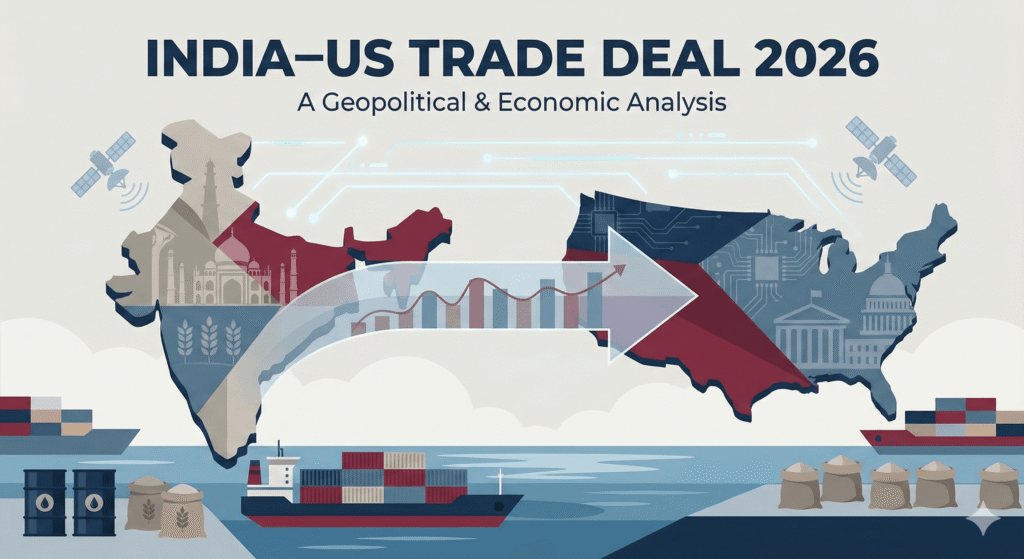
What Does This Trade Deal Mean for the Bigger Geopolitical Picture?

Quick Answer: The deal signals India moving back into the US orbit — and away from the Russia-China axis that had been deepening over the past year.

Over the past year, as US-India trade tensions worsened, India quietly deepened ties with both China and Russia. In August 2025, China and India pledged to be “partners not rivals.” In September, the leaders of India, China, and Russia displayed notable solidarity at the Shanghai Cooperation Organisation summit.

But this trade deal could shift that dynamic. Analysts believe that if the rapprochement with the US proves durable, India will likely “gravitate back to the US bloc.” The energy component is particularly telling — cutting Russian oil and buying American crude isn’t just a trade move. It’s a geopolitical realignment.

Senator Jim Risch, chair of the US Senate Foreign Relations Committee, was blunt about it: he welcomed the deal partly because it would “support efforts to curb Russian aggression” by reducing India’s dependence on Russian energy.

What Are the Key Unanswered Questions About US-India Trade Deal Right Now?

Quick Answer: A lot. From the scope of the deal to India’s Russian oil commitments to the $500 billion purchasing pledge — clarity is still very much needed.

  1. What products are actually covered? No one has released a product-by-product list. Exporters are waiting for a US executive order to get clarity.
  2. Will India really cut tariffs to zero? Trump said yes. India hasn’t confirmed. Especially in agriculture and regulated imports, this seems like a stretch.
  3. How will India replace Russian oil? India imports about 1.2 million barrels per day from Russia. Replacing that with US and Venezuelan crude is logistically and financially complex.
  4. What about Chabahar Port and Iran? The US has threatened sanctions on countries doing business with Iran. India’s 23-year investment in Iran’s Chabahar port may quietly disappear — and the 2026 Union Budget shows no allocation for it.
  5. Is the $500 billion figure real? Given that India’s total annual imports from the US are under $50 billion, this figure — if genuine — would have to play out over a decade or more.

The Bottom Line

The India-US trade deal of February 2026 is genuinely significant. After a year of punishing tariffs, stalled diplomacy, and real economic damage to Indian exporters, this agreement represents a meaningful reset. It brings India’s tariff rate in line with its Asian peers, opens doors for sectors that were struggling, and signals a warming of ties between the world’s two largest democracies.

But it’s important to stay grounded. The legal text isn’t finalised. Many of Trump’s claims haven’t been confirmed by India. The agriculture question is still a political hot potato. And the sheer scale of some of the commitments — like the $500 billion purchasing pledge — raises eyebrows.

What’s clear is that this is a beginning, not an end. Both sides have signalled that more negotiations, more phases, and more deals are coming. The real test will be in the implementation — and that story is just getting started.

Latest: Read about the changes in Customs Duties in Budget 2026. Click Here.

Frequently Asked Questions (FAQ)

Q: What is the India-US trade deal 2026 about?

A: It’s an agreement where the US reduced reciprocal tariffs on Indian goods from 50% to 18%, and India committed to lowering its own trade barriers on American products, shifting away from Russian oil, and purchasing large quantities of US goods.

Q: Why did the US cut tariffs on Indian goods?

A: The tariff cut followed a phone call between PM Modi and President Trump. Trump cited “friendship and respect” and said India agreed to several conditions, including stopping Russian oil purchases and opening its markets to US products.

Q: What was the tariff rate on Indian goods before India-US Trade deal?

A: It was effectively 50% — a combination of a 25% reciprocal tariff and an additional 25% penalty tariff imposed because of India’s purchases of Russian oil. This made India one of the most heavily tariffed US trading partners.

Q: Has India officially agreed to stop buying Russian oil?

A: Trump claimed Modi agreed to cease Russian oil purchases. India has not publicly confirmed this specific commitment. However, Indian refiners had already begun reducing Russian crude imports in late 2025 and early 2026.

Q: Is the $500 billion purchasing commitment real?

A: Trump claimed India would buy over $500 billion worth of US products. India has not confirmed this figure. Given that India’s current annual imports from the US are under $50 billion, this would need to play out over many years if true.

Q: Which Indian sectors will benefit most from the deal?

A: Textiles, apparel, engineering exports, gems & jewellery, auto components, and IT services are expected to gain the most. These are the sectors that were hit hardest by the 50% tariffs.

Q: Why is agriculture such a big deal in this trade agreement?

A: About 50% of India’s population depends on agriculture for livelihoods. Opening Indian markets to US farm products — especially GMOs — is politically sensitive and could affect millions of Indian farmers.

Q: Is this a final trade deal or just the beginning?

A: This is widely considered a “Phase One” agreement. The legal text is still being finalised, and both governments have indicated that a more comprehensive Free Trade Agreement will be negotiated in the months ahead.

Q: How does the 18% tariff compare to other countries?

A: India is now on par with Vietnam (20%), Thailand (19%), and Malaysia (19%). It’s well below China (37%), Brazil (50%), and South Africa (30%), but slightly above the EU, Japan, and South Korea (all at 15%).

Q: What role did energy play in the deal?

A: Energy was a central pillar. The US wanted India to stop buying cheap Russian oil and shift to American crude (and possibly Venezuelan oil). India’s agreement on this was a key factor in the tariff reduction.

Q: How did the Indian rupee and stock markets react?

A: Markets reacted very positively. The rupee surged 119 paise to 90.3 against the dollar. US-listed Indian stocks like Infosys, Wipro, and HDFC Bank all rallied between 3% and 7%.

Q: What is the significance of the deal for India-China relations?

A: Over the past year, India had been deepening ties with both China and Russia as US relations deteriorated. This trade deal could pull India back toward the US geopolitical bloc, potentially changing the India-China-Russia dynamic.

Q: What happens to India’s Chabahar port project in Iran?

A: The US has threatened sanctions on countries doing business with Iran. India’s Union Budget for 2026 shows no allocation for the Chabahar port project, suggesting the government may quietly step back from the 23-year investment.

Q: Who negotiated this deal on both sides?

A: The deal came together after months of back-channel talks, with key contributions from External Affairs Minister S. Jaishankar, Indian Ambassador Vinay Kwatra, and US Ambassador Sergio Gor. The final breakthrough came from a direct Modi-Trump phone call.

Q: When will we know the full details of the agreement?

A: Exporters and trade experts are waiting for a US executive order and the formal negotiated text. Both governments have indicated that sector-specific details, timelines, and compliance mechanisms will be released in the coming weeks and months.

sunshine cargo services
private limited

Head Office Address:
Marshall House, Room 574, 33/1, N.S. Road/25, Strand Road, Kolkata West Bengal 700001

Contact:
Deepak Kumar:
+91-98300-66760
Manish Kumar:
+91-98363-29801

Email:
su************@***oo.com

Working Hours:
Monday-Friday: 10:00 AM to 18:00 PM
Saturday: 10:00 AM to 14:00 PM
Closed on Sundays and Indian Government Holidays.

Service Offices:
Raxaul, Bihar, India
Jogbani, Bihar, India

All Rights Reserved by Sunshine Cargo Services Private Limited.

Developed by FresioMedia.

Scroll to Top