Akash Gupta | AI Generalist & Content Specialist, Sunshine Cargo Services, Kolkata, India — January 27th, 2026
TL;DR
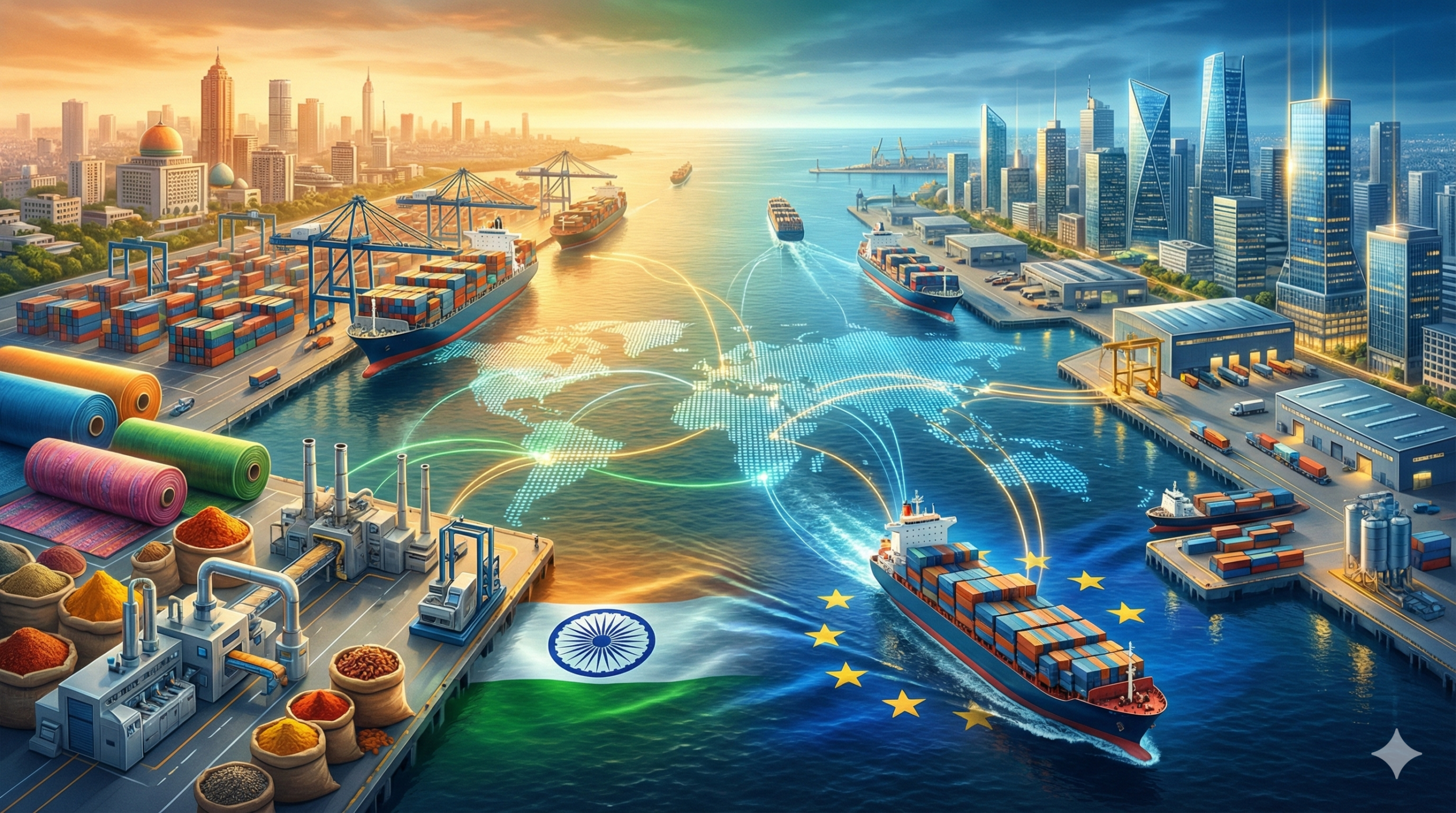
The India-EU FTA 2026 is a game-changer for Indian exporters! 🇮🇳🇪🇺
- 99% of exports get tariff-free EU access
- $33B in textiles, leather & gems benefit immediately
- 450M European consumers now accessible
- Easier mobility for IT professionals
Read the complete guide ⬇️
Quick Summary
On January 27, 2026, India and the European Union announced a historic Free Trade Agreement that will revolutionize trade between these two economic giants. Here’s what you need to know:
✓ Over 99% of Indian exports will get duty-free or reduced tariff access to EU markets
✓ Immediate benefits for textiles, leather, marine products, gems & jewellery worth $33 billion
✓ Better opportunities for Indian IT professionals and service providers in Europe
✓ Access to 450 million European consumers across 27 countries
✓ Enhanced market access for agricultural products like tea, coffee, spices, and processed foods
✓ Simplified customs procedures making it easier and faster to export to Europe
Introduction: A Game-Changer for Indian Business
If you’re an Indian exporter, importer, or business owner looking to expand internationally, today is a big day for you. Prime Minister Narendra Modi and European Commission President Ursula von der Leyen just announced something that could transform your business opportunities forever—the India-EU Free Trade Agreement (FTA).
But what does this actually mean for your business? Will your products really get cheaper access to European markets? Can you now send your team to work in Europe more easily? And most importantly, how can you take advantage of these new opportunities?
Let’s break it all down in simple terms. As your customs clearing partner at Sunshine Cargo Services, we’ve put together this easy-to-understand guide to help you navigate this game-changing agreement.
What Is the India-EU Free Trade Agreement and Why Should You Care?
In Brief: The India-EU FTA is a trade deal that removes or reduces taxes (tariffs) on goods and services traded between India and the European Union’s 27 member countries. It makes your exports cheaper and more competitive in European markets.
Think of it this way: Right now, when you export goods to Germany, France, or any EU country, your products face import duties that can be anywhere from 5% to 12% or even higher. These duties make your products more expensive for European buyers.
With the FTA, most of these duties disappear. Your textile shirt that cost €50 in Europe (with duties) might now cost €45. That €5 difference can be a huge competitive advantage or extra profit in your pocket.
The Big Numbers You Need to Know
Here’s the scale we’re talking about:
- India is the world’s 4th largest economy
- European Union is the world’s 2nd largest economy
- Together, we represent 25% of the world’s GDP
- We account for one-third of global trade
- The EU has 450 million consumers ready to buy Indian products
In 2024-25, India’s trade with the EU was already massive:
- Total trade in goods: ₹11.5 lakh crore (USD 136.54 billion)
- Indian exports to EU: ₹6.4 lakh crore (USD 75.85 billion)
- Trade in services: ₹7.2 lakh crore (USD 83.10 billion)
Now imagine what happens when trade barriers come down!
How Much Market Access Will Indian Exporters Really Get?
In Brief: Indian exporters will get preferential (reduced or zero tariff) access for over 99% of exports by value to EU markets. This is unprecedented and one of the best trade deals India has ever signed.
Let me put this in perspective. When we say “99% of exports,” we’re not just talking about small numbers. We’re talking about:
- USD 75 billion worth of exports getting better market access
- USD 33 billion in labour-intensive sectors getting immediate tariff elimination
- Tariffs as high as 10% dropping to zero on day one of implementation
What Does “Preferential Access” Actually Mean?
In simple terms:
- Before FTA: Your leather jacket faces 4-8% duty when entering France
- After FTA: Your leather jacket enters France at 0% duty
- Result: You can price it lower and still make the same profit, or keep the price same and make more profit
This isn’t just theory. Every percentage point of tariff reduction translates directly into better competitiveness or higher margins for your business.
Which Indian Industries Will Benefit the Most from This Deal?
In Brief: Labour-intensive sectors like textiles, leather, footwear, marine products, gems & jewellery, and handicrafts will see immediate and massive benefits. Agricultural products and engineering goods will also gain significantly.
The FTA is designed to boost sectors that employ the most people in India. Here’s who wins big:
1. Textiles and Apparel Industry
Current situation: Indian garments face 9.6-12% tariffs in EU
After FTA: Zero tariffs immediately
What this means: If you’re exporting cotton shirts worth €20, you save €2 per shirt. For a container with 10,000 shirts, that’s €20,000 in savings or competitive advantage!
Indian textile and apparel exporters will compete on equal footing with Bangladesh, Vietnam, and other countries that already have preferential access to EU markets.
2. Leather and Footwear Industry
Current situation: Leather goods face 2-8% tariffs
After FTA: Zero tariffs
What this means: Indian leather products, already known for quality, will become even more price-competitive. Italian and Spanish buyers will find it more attractive to source from India.
3. Marine Products (Seafood)
Current situation: Seafood faces 7-18% tariffs
After FTA: Significantly reduced or zero tariffs
What this means: Coastal exporters of shrimp, fish, and other seafood products will see demand surge from European markets. This benefits fishing communities across India’s coastline.
4. Gems and Jewellery
Current situation: Polished diamonds face 0-2.5% tariffs, but jewellery faces higher rates
After FTA: Enhanced access with reduced tariffs
What this means: India’s gem and jewellery industry, already a global leader, will strengthen its position in European luxury markets.
5. Handicrafts and Handlooms
Current situation: Variable tariffs depending on product
After FTA: Preferential access
What this means: Artisans and craftspeople will have direct access to European buyers who value handmade, authentic Indian products. This supports traditional industries and rural employment.
6. Engineering Goods and Auto Parts
Current situation: Various tariffs depending on product category
After FTA: Reduced tariffs
What this means: Indian manufacturers of auto components, machinery, and engineering products will integrate better into European supply chains.
What About the Automobile Sector? Can Indian Cars Now Enter Europe Easily?
In Brief: The auto sector has a carefully designed quota-based system that allows European cars in higher price segments to enter India while also opening doors for Indian manufacturers to export to Europe and establish “Make in India” operations.
The automobile provisions are smart and strategic:
For European Automakers Coming to India:
- They can introduce premium and luxury models in India’s higher price bands
- Encourages them to set up manufacturing in India (Make in India)
- Creates jobs and technology transfer opportunities
For Indian Automakers:
- Reciprocal access to EU markets for India-made automobiles
- Opportunity to export from India to Europe
- Level playing field for Indian brands in European markets
For Indian Consumers:
- Access to more high-tech European vehicles
- Greater competition leading to better prices
- More choices in premium segments
Important: This isn’t about flooding India with imported cars. It’s about creating opportunities for both sides while protecting domestic manufacturing.
Will Indian Farmers and Agricultural Exporters Benefit from This FTA?
In Brief: Yes! Agricultural products like tea, coffee, spices, fresh fruits, vegetables, and processed foods will get enhanced market access. However, India has protected sensitive sectors like dairy and cereals—no imports allowed in these categories.
Agricultural Products That Will Gain:
Tea and Coffee
- India’s Darjeeling tea, Assam tea, and South Indian coffee are already famous in Europe
- Reduced tariffs will make them more affordable for European consumers
- Creates opportunities for organic and specialty tea/coffee exporters
Spices
- Indian spices are globally recognized
- Better access to European food industry and retail chains
- Supports small farmers and spice traders
Fresh Fruits and Vegetables
- Seasonal exports will benefit from streamlined procedures
- Better cold chain and logistics cooperation
- Opportunities for organic and exotic fruits
Processed Foods
- Ready-to-eat Indian foods, pickles, sauces, snacks
- Growing European interest in Indian cuisine
- Value addition benefits farmers and food processors
What India Has Protected:
To safeguard farmers and food security, India has NOT opened up these sectors:
- Dairy products (no EU dairy imports)
- Cereals and grains
- Poultry
- Soymeal
- Certain sensitive fruits and vegetables
This balanced approach means you can export more while your domestic agricultural sector stays protected.
What Non-Tariff Benefits Does This FTA Provide?
In Brief: Beyond just reducing tariffs, the FTA simplifies customs procedures, reduces red tape, improves regulatory cooperation, and makes it easier to meet European standards. This saves time and money.
Tariff reduction is just one part of the story. Here’s what else you get:
1. Streamlined Customs Procedures
- Faster clearance at European ports
- Less paperwork and documentation
- Digital processes for smoother trade
- Reduced cargo dwell time
What this means for you: Your shipment that used to take 3 days to clear customs might now clear in 1 day. Time is money in international trade!
2. Better Regulatory Cooperation
- Indian and EU authorities working together on standards
- Mutual recognition of testing and certification
- Less duplication of compliance requirements
What this means for you: Instead of testing your product twice (once in India, once in EU), you might need to test just once.
3. Improved SPS (Sanitary and Phytosanitary) Procedures
- Clearer guidelines for food safety and plant health
- Faster approvals for agricultural products
- Better information sharing
What this means for you: Agricultural exporters face less uncertainty and rejection at European borders.
4. Technical Barriers to Trade (TBT) Discipline
- Easier to understand European technical standards
- Support for meeting EU requirements
- Transparency in regulation changes
What this means for you: You’ll know exactly what standards your product needs to meet, reducing costly mistakes.
How Does the FTA Address Carbon Border Taxes (CBAM)?
In Brief: The FTA includes forward-looking provisions to help Indian exporters deal with Europe’s Carbon Border Adjustment Mechanism. You’ll get technical support, financial assistance, and fair treatment to reduce your carbon footprint.
CBAM (Carbon Border Adjustment Mechanism) is Europe’s way of ensuring imported products pay for their carbon emissions. Without the FTA protections, this could have been very expensive for Indian exporters in sectors like:
- Steel and iron
- Cement
- Aluminum
- Fertilizers
- Electricity
What the FTA Secures for Indian Exporters:
Most-Favored Nation Treatment
- If EU gives benefits to other countries on CBAM, India gets the same
- Ensures you’re not discriminated against
Recognition of Indian Carbon Pricing
- Your carbon reduction efforts in India will be recognized
- Less burden of proving compliance
Recognition of Indian Verifiers
- You can use Indian agencies to verify your emissions
- No need to hire expensive European verifiers
Financial and Technical Support
- Help to reduce your greenhouse gas emissions
- Training and technology transfer to meet requirements
- Investment support for cleaner production
What this means for you: If you’re in steel, cement, or aluminum, you won’t face sudden, unmanageable costs. You’ll have time, support, and fair treatment to adapt.
What Opportunities Are There for Indian Service Providers and IT Professionals?
In Brief: Massive opportunities! The FTA provides market access for IT/ITeS, professional services, education, financial services, and more. Plus, there’s a comprehensive mobility framework allowing Indian professionals to work in Europe more easily.
Services are where India really shines, and this FTA recognizes that.
Market Access for Services:
India Gets Access to 144 EU Subsectors:
- IT and IT-enabled Services
- Professional Services (law, accounting, engineering, consulting)
- Education Services
- Financial Services
- Tourism and Hospitality
- Construction Services
- Other Business Services
EU Gets Access to 102 Indian Subsectors:
- Brings high-tech European services to India
- Investment and technology transfer
- Win-win for both sides
The Big Deal: Professional Mobility
One of the most exciting parts of the FTA is how it makes it easier for Indian professionals to work in Europe.
Intra-Corporate Transfers (ICT)
- Your company can send employees to work in your European office
- Includes working rights for spouses and children
- More predictable process than before
Business Visitors
- Short-term business travel made easier
- Attend meetings, negotiate contracts, explore opportunities
- Streamlined visa processes
Contractual Service Suppliers (CSS)
- EU has opened 37 sectors for Indian professionals working on contracts
- Includes IT, consulting, R&D, education
- Fixed-term projects become easier to manage
Independent Professionals
- Self-employed Indian professionals get access to 17 sectors in EU
- Freelancers and consultants can offer services more easily
- Great for skilled professionals wanting to work independently
Special Benefits:
Social Security Agreements
- Framework to negotiate over 5 years
- Prevents double taxation
- Ensures your social security contributions are portable
Students and Post-Study Work
- Better opportunities for Indian students in Europe
- Post-study work options
- Pathway to professional opportunities
Traditional Medicine Practitioners
- Ayurveda, Yoga, Naturopathy practitioners can work in EU
- Recognition under home title where traditional medicine isn’t regulated
- Growing European interest in holistic health
What this means for you: If you’re in IT, consulting, or professional services, Europe just became a much more accessible market for your talent.
How Will the FTA Help Small and Medium Businesses (MSMEs)?
In Brief: The FTA has a dedicated SME chapter with special provisions to help small businesses understand and use the agreement. MSMEs will get information support, simplified procedures, and access to resources.
Let’s be honest—big companies have teams of trade lawyers and customs experts. Small businesses don’t. The FTA recognizes this and includes special help for MSMEs:
SME-Specific Provisions:
Information and Guidance
- Clear, accessible information about how to use the FTA
- Helpdesks and contact points
- Simplified explanations of complex rules
Reduced Compliance Burden
- Streamlined procedures for smaller shipments
- Less red tape for SMEs
- Digital tools for easier compliance
Capacity Building
- Training programs for MSMEs
- Help understanding European market requirements
- Support for meeting standards and certifications
What this means for you: Even if you’re a small manufacturer or trader, you can benefit from this FTA without hiring expensive consultants (though we at Sunshine Cargo Services are always here to help!).
What About Digital Trade and E-Commerce Opportunities?
In Brief: The FTA includes modern provisions for digital trade, making it easier for Indian businesses to sell services online, operate digital platforms, and engage in e-commerce with European customers.
We live in a digital age, and the FTA reflects that:
Digital Trade Provisions:
E-Commerce
- Clearer rules for online trade
- Protection for digital businesses
- Non-discriminatory treatment for digital services
Digitally Delivered Services
- Indian software, apps, online courses, and digital content get better access
- Certainty in regulations
- Protection of intellectual property
What this means for you: If you run an online business, software company, or digital services firm, you’ll have more predictability and protection when serving European customers.
How Does the FTA Protect Intellectual Property and Traditional Knowledge?
In Brief: The FTA strengthens IP protection in line with international standards and specifically recognizes India’s Traditional Knowledge Digital Library, helping prevent biopiracy of Indian traditional knowledge.
Intellectual Property Coverage:
The FTA protects:
- Copyrights and related rights
- Trademarks and geographical indications (like Darjeeling Tea, Basmati Rice)
- Industrial designs and patents
- Trade secrets
- Plant varieties
- Enforcement mechanisms
Special Recognition for Traditional Knowledge:
Traditional Knowledge Digital Library (TKDL)
- India’s database of traditional knowledge gets formal recognition
- Helps prevent foreign companies from patenting Indian traditional knowledge
- Protects Ayurveda, Yoga, Unani, and other traditional practices
What this means for you: Your innovations, brands, and traditional knowledge are protected when doing business in Europe.
What Is India’s Broader Trade Agreement Strategy?
In Brief: The EU becomes India’s 22nd FTA partner. Combined with recent agreements with UK and EFTA, India now has comprehensive access to the entire European market. This is part of India’s strategy to become a global trade powerhouse by 2047.
India isn’t putting all its eggs in one basket. Here’s the bigger picture:
India’s Recent Trade Deals:
Since 2014, India has signed FTAs with:
- Mauritius
- United Arab Emirates (UAE)
- Australia
- EFTA (Switzerland, Norway, Iceland, Liechtenstein)
- United Kingdom (2025)
- Oman (2025)
- New Zealand (concluded 2025)
- European Union (2026) ← We are here!
What This Means:
Complete European Market Access
- EU FTA (27 countries)
- UK FTA (1 country)
- EFTA FTA (4 countries)
- = 32 European countries with preferential access!
This gives Indian exporters access to virtually the entire European market—over 500 million consumers with high purchasing power.
Vision: Viksit Bharat 2047
These trade agreements support India’s vision of becoming a developed nation by 2047 (100 years of independence). The strategy is to:
- Integrate into global value chains
- Become a trusted manufacturing hub
- Create millions of jobs
- Drive inclusive growth
What this means for you: As an Indian business, you’re part of a larger national strategy to become a global trading powerhouse. The government is creating the framework; you get to use it.
When Will the FTA Actually Start Working?
In Brief: The FTA has been concluded and announced, but it still needs to go through ratification processes in both India and the EU before it becomes active. The exact timeline will be announced soon, but businesses should start preparing now.
Current Status:
Announced: January 27, 2026 ✓
Signed: Pending
Ratified by India: Pending
Ratified by EU Parliament: Pending
Entry into Force: To be announced
What You Should Do Now:
Even though the FTA isn’t active yet, this is the perfect time to:
- Understand the Benefits: Know which tariffs will be eliminated on your products
- Prepare Documentation: Get your export documentation in order
- Study Rules of Origin: Understand what qualifies as “Made in India” for FTA purposes
- Identify New Markets: Research which EU countries are best for your products
- Contact Customs Experts: Talk to us at Sunshine Cargo Services to create an FTA strategy
What this means for you: Don’t wait for the FTA to start. Prepare now so you can hit the ground running on day one!
How Can Your Business Actually Use This FTA? (Practical Steps)
In Brief: To benefit from the FTA, you need to ensure your products meet “rules of origin” requirements, get the right certificates, classify your products correctly, and work with experienced customs clearing agents who understand the FTA.
Here’s your practical action plan:
Step 1: Understand Rules of Origin
Not every product qualifies for preferential tariffs automatically. Your product needs to be:
- Wholly obtained in India (like agricultural products grown here), OR
- Sufficiently transformed in India (like textiles made from imported fiber but woven, dyed, and finished in India)
Each product category has specific rules. This is where expert help becomes crucial.
Step 2: Get Certificates of Origin
To claim FTA benefits, you need a Certificate of Origin proving your product qualifies. This is issued by:
- Export Inspection Council
- Designated agencies
- Electronic systems (in the future)
Your customs agent (that’s us!) can help you obtain these certificates correctly.
Step 3: Classify Your Products Correctly
Every product has an HS (Harmonized System) code. The tariff benefit you get depends on this classification. Even a small error can cost you:
- Loss of preferential tariff
- Penalties
- Customs delays
Professional classification is essential.
Step 4: Understand Tariff Schedules
The FTA has detailed tariff schedules showing:
- Which products get immediate duty elimination
- Which get phased reduction over years
- Exactly what percentage you save
You need to know your specific product’s schedule.
Step 5: Ensure Compliance
Beyond tariffs, you still need to meet:
- Product standards (EU regulations)
- Labeling requirements
- Safety certifications
- Environmental compliance
- Documentation requirements
Step 6: Work with Experienced Partners
This is where Sunshine Cargo Services comes in. We help you:
- Navigate rules of origin
- Prepare correct documentation
- Classify products accurately
- Clear customs smoothly
- Stay compliant with all requirements
- Maximize your FTA benefits
What this means for you: The FTA creates opportunities, but you need expertise to capture them. Don’t leave money on the table due to documentation errors or compliance issues.
What Are the Potential Challenges and How Can You Overcome Them?
In Brief: Challenges include understanding complex rules of origin, meeting EU product standards, managing logistics, and ensuring compliance. These are all manageable with the right preparation and partners.
Let’s be realistic—every opportunity comes with challenges. Here’s what to watch for:
Challenge 1: Complex Rules of Origin
The Issue: Understanding whether your product qualifies can be complicated
The Solution: Work with customs experts who specialize in FTA rules of origin. We help you verify qualification before you ship.
Challenge 2: Meeting EU Standards
The Issue: EU has strict product standards, especially for food, toys, electronics, chemicals
The Solution: Research requirements early. Get products tested and certified. We can connect you with testing agencies.
Challenge 3: Documentation Requirements
The Issue: Incorrect or incomplete documentation leads to delays and lost benefits
The Solution: Systematic documentation process. Checklists. Expert review before shipping.
Challenge 4: Language and Cultural Differences
The Issue: Negotiating with European buyers across language and culture barriers
The Solution: Use professional translators for contracts. Research business etiquette in target countries. Start with English-speaking countries if unsure.
Challenge 5: Logistics and Shipping
The Issue: Managing international logistics, dealing with delays, handling damages
The Solution: Work with experienced freight forwarders. Insure your cargo. Use reliable shipping lines.
Challenge 6: Payment and Currency Risk
The Issue: Getting paid across borders, currency fluctuations
The Solution: Use secure payment methods (LC, escrow). Consider currency hedging for large contracts.
What this means for you: Yes, there are challenges, but they’re all solvable. Thousands of Indian businesses already export successfully to Europe. With the FTA, it just got easier.
Frequently Asked Questions (FAQ)
1. When will the India-EU FTA actually become effective?
The FTA was announced on January 27, 2026, but still needs to be formally signed and then ratified by both India’s Parliament and the European Union’s institutions. The exact date of entry into force will be announced after these processes are complete. However, businesses should start preparing immediately rather than waiting for the official start date.
2. Will all Indian products get zero tariff access to EU markets?
Over 99% of Indian exports by value will get preferential (reduced or zero) tariff access. However, some products will have tariffs eliminated immediately, while others will be phased out over several years. A few sensitive products may retain some tariffs. You need to check your specific product’s tariff schedule.
3. Do I need to do anything special to claim FTA benefits?
Yes! You need to obtain a Certificate of Origin proving your product meets the FTA’s “rules of origin” requirements. You also need to ensure your customs documentation correctly references the FTA. Simply shipping to Europe won’t automatically give you the benefits—you must claim them properly.
4. What are “rules of origin” and why do they matter?
Rules of origin are criteria that determine whether a product is genuinely “Made in India” or just trans-shipped through India. To qualify for FTA benefits, your product must either be wholly obtained in India (like agricultural products) or undergo substantial transformation in India (like manufacturing). If you just import finished goods from China and re-export them to EU, they won’t qualify.
5. I’m a small exporter. Is this FTA only for big companies?
Not at all! The FTA specifically includes an SME (Small and Medium Enterprise) chapter designed to help small businesses. In fact, labour-intensive sectors that benefit most (textiles, handicrafts, leather) are dominated by MSMEs. The benefits are available to businesses of all sizes.
6. How much money can I actually save on tariffs?
It depends on your product. For example, if you export textiles currently facing 10% tariffs, and your annual exports are €100,000, you’ll save €10,000 per year. For gems and jewellery, leather goods, or engineering products, the savings can be substantial. We can help you calculate your specific savings.
7. Will I face competition from cheaper European imports in India?
The FTA is reciprocal, meaning European products also get easier access to India. However, India has protected sensitive sectors (like dairy, cereals, and certain agricultural products). Additionally, Indian manufacturers will benefit from access to better technology and cheaper inputs from Europe, making them more competitive.
8. Can Indian professionals now work in Europe more easily?
Yes! The FTA includes a comprehensive mobility framework covering Intra-Corporate Transfers, Business Visitors, Contractual Service Suppliers, and Independent Professionals. While this doesn’t mean automatic work visas, it creates a more predictable and facilitated process compared to before.
9. What is CBAM and should I be worried about it?
CBAM (Carbon Border Adjustment Mechanism) is the EU’s carbon tax on imports in sectors like steel, cement, and aluminum. The FTA includes protections ensuring you get fair treatment, technical support, recognition of Indian carbon pricing, and financial assistance to comply. If you’re in affected sectors, you’ll need to track and report emissions, but you’ll have support to do so.
10. How do I know if my product qualifies for tariff benefits?
You need to: (1) Check your product’s HS code classification, (2) Review the FTA’s tariff schedule for that HS code, (3) Verify your product meets the rules of origin for that category, and (4) Obtain appropriate certification. This is where customs clearing experts like Sunshine Cargo Services can help—we’ll guide you through the entire process.
11. What documents do I need to export under this FTA?
You’ll need standard export documents (commercial invoice, packing list, bill of lading) plus FTA-specific documents: Certificate of Origin, declaration of compliance with rules of origin, and proper customs declarations referencing the FTA. Product-specific documents (like SPS certificates for food) still apply.
12. Can I use the FTA for goods that transit through other countries?
Generally, yes, as long as goods remain under customs supervision during transit and don’t undergo any processing in the transit country. However, there are specific rules about what constitutes acceptable transit and handling. Direct shipping is always simpler and safer.
13. What happens if my Certificate of Origin is incorrect or rejected?
If your Certificate of Origin is rejected, your shipment will face normal (MFN) tariff rates rather than preferential FTA rates, meaning you lose the tariff benefit and might make less profit or no profit on that shipment. In severe cases, there could be penalties for false declarations. This is why accurate documentation is crucial.
14. How does this FTA compare to India’s other trade agreements?
The India-EU FTA is one of India’s most comprehensive trade agreements. Combined with the UK FTA and EFTA FTA, it gives Indian exporters access to virtually the entire European market. It’s considered more ambitious than many of India’s earlier FTAs, especially in services and mobility provisions.
15. How can Sunshine Cargo Services help me benefit from this FTA?
We provide comprehensive FTA utilization services including: (1) Rules of origin consultation and verification, (2) Certificate of Origin procurement, (3) HS code classification, (4) Customs documentation and clearance, (5) Compliance with EU regulations, (6) Tariff schedule analysis for your products, (7) Training on FTA procedures, and (8) End-to-end export/import support. Basically, we make sure you get maximum benefits with minimum hassle.
Final Thoughts: This Is Your Opportunity—Are You Ready to Seize It?
The India-EU Free Trade Agreement isn’t just another government announcement. It’s a real, tangible opportunity for Indian businesses to expand, grow, and compete on the global stage.
Think about it:
- 450 million new customers in one of the world’s wealthiest regions
- Billions in tariff savings across industries
- Simpler procedures making trade faster and easier
- Professional mobility opening doors for Indian talent
- Strategic support for everything from carbon compliance to traditional knowledge protection
But here’s the thing: opportunities don’t capture themselves. The FTA creates the framework, but you need to act on it.
Your Next Steps:
- Assess Your Opportunity: Which of your products can benefit? What tariffs will disappear?
- Understand Requirements: What do you need to do to qualify for benefits?
- Prepare Your Business: Documentation, compliance, quality standards—get ready.
- Find the Right Markets: Which EU countries are best for your products?
- Partner with Experts: Don’t navigate this alone. Work with people who live and breathe international trade.
How Sunshine Cargo Services Can Be Your FTA Partner
At Sunshine Cargo Services Pvt. Ltd., we’ve been helping Indian businesses navigate international trade for years. We understand customs procedures, trade agreements, and the practical realities of getting your goods from India to anywhere in the world.
With the India-EU FTA, we’re ready to help you:
- Maximize tariff savings through proper documentation
- Ensure compliance so your shipments clear smoothly
- Reduce errors that can cost you time and money
- Scale your operations as you grow in European markets
- Stay updated on FTA implementation and changes
We don’t just clear customs. We help you build a sustainable, profitable import business.
Ready to Get Started?
The India-EU FTA represents one of the biggest trade opportunities India has seen in decades. Your competitors are already planning how to use it. Are you?
Contact Sunshine Cargo Services today. Let’s sit down, look at your products, and create a concrete plan to help you benefit from this historic agreement.
The European market is waiting. Let’s help you get there.
Disclaimer: This blog post is for informational purposes only and is based on official announcements made on January 27, 2026. For specific advice regarding your business situation, please consult with our trade experts or relevant government authorities. Trade policies and procedures may change, and businesses should verify current requirements before making decisions.
Source: Press Information Bureau, Government of India, Ministry of Commerce & Industry | January 27, 2026

sunshine cargo services
private limited
Head Office Address:
Marshall House, Room 574, 33/1, N.S. Road/25, Strand Road, Kolkata West Bengal 700001
Contact:
Deepak Kumar: +91-98300-66760
Manish Kumar: +91-98363-29801
Email:
su************@***oo.com
Working Hours:
Monday-Friday: 10:00 AM to 18:00 PM
Saturday: 10:00 AM to 14:00 PM
Closed on Sundays and Indian Government Holidays.
Service Offices:
Raxaul, Bihar, India
Jogbani, Bihar, India
All Rights Reserved by Sunshine Cargo Services Private Limited.
Developed by FresioMedia.